
Plastic Steel Door or Plastic Door? A UPVC Buyer's Guide
A plastic steel door and a plastic door are separated by one structural fact: the plastic steel door — sold in export documentation as a UPVC door — carries galvanized steel liners inside its PVC-U profile chambers, while a plain plastic door has no steel reinforcement at all. That single difference decides whether the door can be used on an exterior wall, how it behaves under wind load, and how likely it is to stay straight in service.
Buyers usually meet both names in the same enquiry. One supplier quotes a plastic steel door, another quotes a plastic door or a PVC door, and the prices differ by a margin that photographs cannot explain. This guide covers what each term describes, what the reinforcement does, where each door belongs, and how to confirm at specification and at acceptance which construction you have actually been offered.
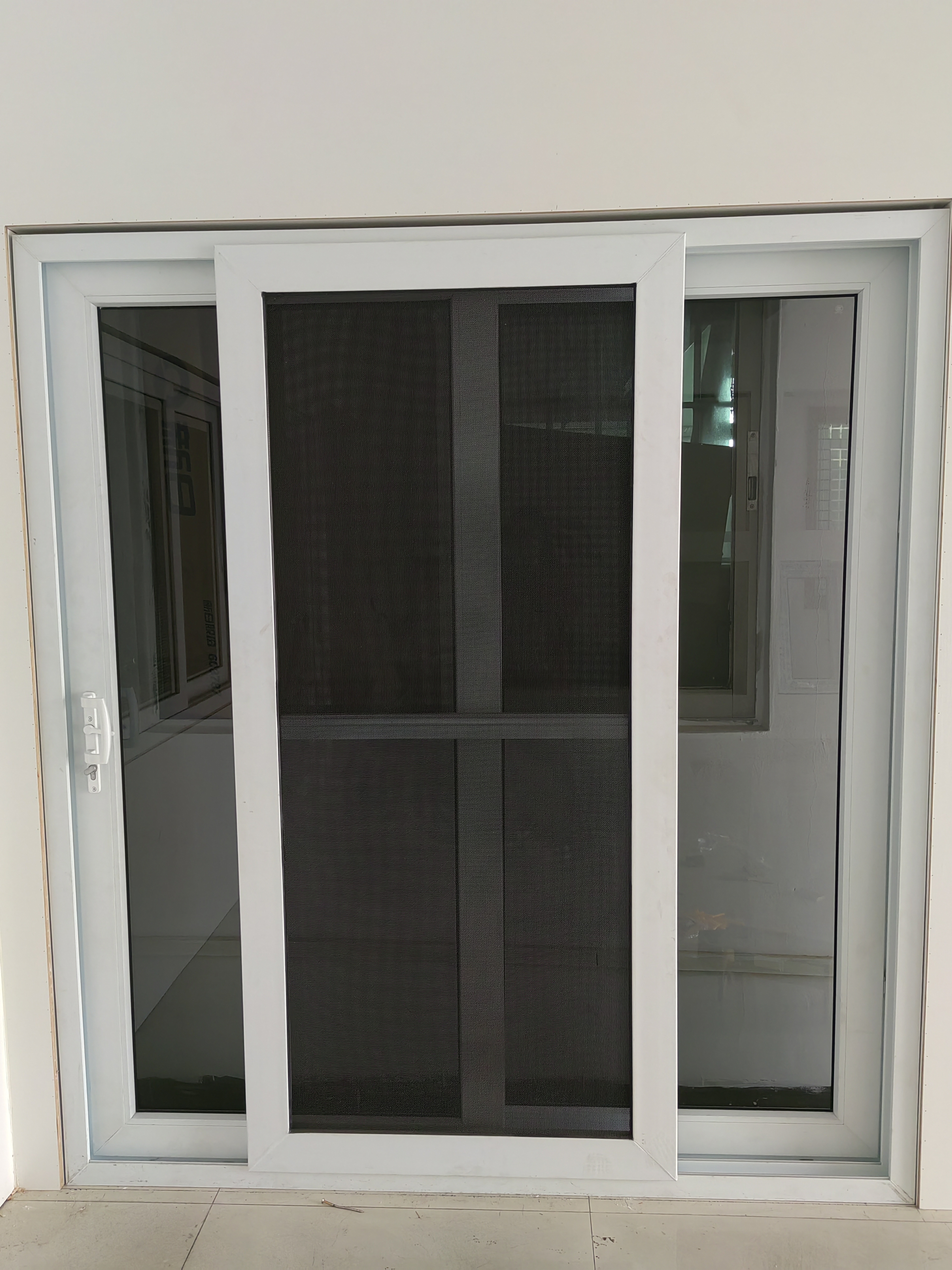
A steel-lined UPVC door: 112/88-series sliding door with fly screen. The visible frame profile is where the reinforcement sits.
Why one product carries two names
The two names come from two different routes into English, and both remain in everyday sourcing use.
The first route is trade language. In Chinese-language sourcing the reinforced product is commonly called by a name that translates literally as plastic-steel door, and that literal translation travels into English quotations, chat messages and proforma invoices. The second route is technical language: the profile compound is PVC-U, unplasticized polyvinyl chloride, usually written UPVC or uPVC, so the finished product appears in catalogues, test reports and customs paperwork as a UPVC door.
In normal export usage both names describe the same construction. The reference material behind this guide states it directly: plastic-steel doors are UPVC doors, built on PVC-U profiles with internal galvanized steel liners for reinforcement.
That equivalence is a useful starting point, not a guarantee about a particular quotation. Two suppliers can both write UPVC door and still mean different profile series, different wall sections and different reinforcement practice. The reinforcement question therefore belongs in the written enquiry, not in an assumption drawn from the product name.
The structural difference: profile, chamber and liner
A UPVC door is not a solid sheet of plastic. It is assembled from hollow, multi-chamber PVC-U profiles that are cut, reinforced, welded into a frame and sash, then fitted with glazing and hardware. The steel liner is inserted into the profile chambers before assembly, which is why the reinforcement is invisible once the door is finished — the only reliable places to confirm it are the specification and the cut end face of the profile.
Hardware is fixed through the profile wall and into that reinforcement. Typical components on this product family include door handles, hinges, rollers, anti-collision stoppers, dust-proof pile weatherstrip and EPDM sealing gaskets. On a reinforced door these fittings have steel to anchor into; on an unreinforced plastic door they are anchored in plastic alone.
The plain plastic door is the simpler build: PVC profile with no steel liner inside the frame or sash chambers. The reference material describes the consequence plainly — low rigidity, high deformation risk, and unsuitability for exterior building applications.
The material values published for the UPVC door range are recorded in the product specification and include a density of 1520 kg/m³, a Vicat softening point of 86 °C, a flexural modulus of elasticity of 2840 MPa, a tensile yield stress of 43 MPa and a tensile strain at break of 186%. These are measured material properties of the compound, not a performance guarantee for a finished door. The finished door's declared behaviour depends on the profile system, glazing, hardware, size and installation, which is why performance is established by system testing rather than by a single material figure.
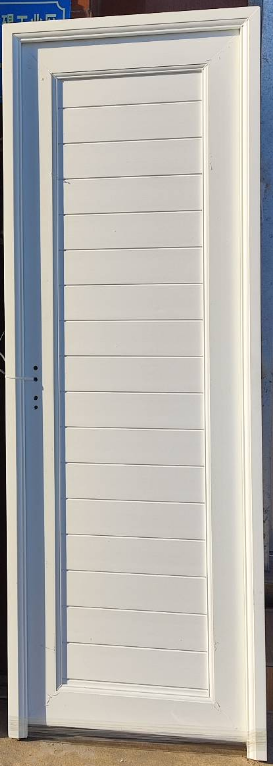
UPVC 60-series full horizontal-panel casement door. Panel layout changes; the reinforced profile system behind it does not.
What a steel liner does, and what it does not guarantee
The liner's job is mechanical. Galvanized steel inside the profile cavities raises rigidity, which is the property that resists deflection under wind pressure and keeps the sash square over time. The reference material credits reinforced UPVC doors with good strength and wind resistance on exactly this basis, and credits unreinforced plastic doors with the opposite: poor rigidity and easy deformation under load.
Three limits are worth stating before you write a purchase order.
First, the liner is a structural component, not a thermal or acoustic one. The sound insulation, heat insulation, water-tight sealing and wind resistance described for this product family come from the whole assembly — profile system, glazing, gaskets and hardware — and the values that matter for a project are the ones declared for that specific door, not a general description of the category.
Second, presence of a liner is not the same as adequacy of a liner. Liner thickness, coating and the extent to which it runs through the frame and sash are specification details. The material available for this guide does not publish those values, so they are a question to put to a supplier in writing rather than a point to assume.
Third, reinforcement does not make a door suitable for every opening. Size, wind zone, exposure, storey height and local access requirements still govern what a given door can be specified for. Reinforcement widens the range of openings a plastic door can serve; it does not remove the need to check the opening.
Plastic steel door vs plastic door at a glance
The table below summarises only the differences that the reference material supports. It is a selection aid, not a performance ranking.
| Point of comparison | Plastic steel door (UPVC door) | Plain plastic door |
|---|---|---|
| Profile construction | PVC-U profile with internal galvanized steel liners for reinforcement | PVC profile with no steel reinforcement |
| Rigidity and wind resistance | Documented good strength and wind resistance | Low rigidity; high deformation risk |
| Where it belongs | Exterior doors, balcony doors and civil engineering projects | Temporary indoor areas and low-demand interior spaces only |
| Exterior or high-rise use | Permitted within the project specification and tested performance | Not suitable; deformation and safety risk |
| Upfront cost | Higher initial cost | Lower initial cost |
| Cost over the project life | Described as cost-effective for real projects, with long service life and stable performance | Cheap upfront, but short service life |
| How to confirm it | Specification check, profile end-face inspection, test reports and Declaration of Performance | Confirmed by the absence of a liner — which is also the limitation |
| Typical failure mode when misapplied | Deformation where reinforcement is missing or insufficient | Deformation under wind load on exterior openings |
Matching the door to the opening
The selection rule in the reference material is short and worth applying literally: reinforced UPVC doors for exterior doors, balcony doors and civil engineering projects; ordinary plastic doors only for temporary indoor areas and low-demand interior spaces, and never for outdoor or high-rise exterior applications.
That rule maps onto the working conditions recorded for this product family: outdoor use, coastal high-humidity and strong-wind areas, across residential buildings, commercial buildings, renovation projects and villa projects. For those openings the listed requirements are wind-pressure resistance, water tightness and air permeability, impact and wear resistance, a secure locking system, weather resistance and anti-aging behaviour, and conformity with local building access standards. A door without reinforcement is being asked to meet those requirements with plastic alone.
Interior openings are a different question. A bathroom or utility door does not carry the same wind load, so the specification conversation shifts to ventilation, privacy, glazing layout and cleaning. Within the range described here, a 75-series bathroom door with a tall upper glass panel and a bottom louver shows how much the layout can be adapted to a wet, ventilated interior space. The reinforcement requirement does not disappear indoors, but the exposure that makes it critical does.
For a distributor assembling a catalogue, the practical implication is that plastic steel door and plastic door should not sit in the same product block with a price difference and no explanation. If both are offered, the listing should state reinforcement, intended location and the verification method, or the buyer will compare on price alone and specify the wrong one.
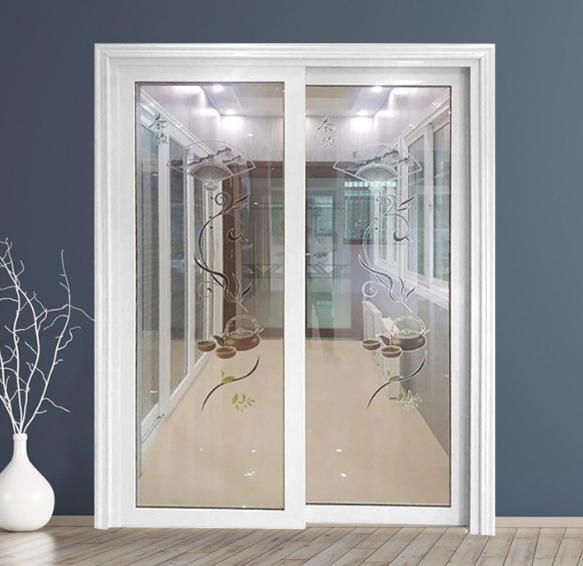
UPVC 88-series sliding door. Exterior and balcony openings are where the reinforcement requirement becomes a safety question rather than a cost question.
How to confirm the construction before you order and at acceptance
Terminology is settled in writing; construction is settled by inspection. The reference material sets out a three-step check that works on both sides of the shipment.
Step 1 — read the technical specification. Confirm that the specification states galvanized steel liners inside the profile, and that it names the profile series and the door model rather than describing the product generically. If the document only says UPVC door, the reinforcement question is still open.
Step 2 — observe the profile end face. On a cut profile end — an offcut, a corner before capping, or the hinge-side end of the frame — the liner is visible as metal inside the cavity. This is the fastest physical confirmation available and it does not require dismantling the door.
Step 3 — reject non-reinforced goods for exterior use. If liners are absent on a door destined for an exterior or high-rise opening, the correct action is replacement with a qualified reinforced door, not acceptance with a price adjustment.
Alongside those steps, five questions are worth putting to any supplier in the enquiry: whether galvanized liners are included and how far they run through frame and sash; which profile series is used; the declared thermal and acoustic values with the supporting test report; the hardware set and opening mode; and the glazing specification. The selection criteria recorded for this product family name the same decisive factors — presence of galvanized steel liners, interior or exterior application, wind-pressure requirement and expected service life.
Standards, paperwork and trade classification
For the EU market, the requirements referenced for this product category include conformity with EN 14351-1:2006+A2:2016 for windows and doors, completion of the required system tests (wind resistance, water tightness, air permeability, sound insulation, thermal performance, drop-weight impact and welding corner strength), a factory production control system, a Declaration of Performance, CE marking on the products, and retention of test reports and technical documentation for inspection. These are market requirements, not a statement that any particular product holds them: certificates and declarations belong to a named product and should be requested for the specific door being quoted.
Regulatory thresholds move, and they move in a direction that rewards better construction. Under the UK Future Homes Standard 2025, the maximum U-value for external doors is reported to fall from 1.6 W/m²K to 1.2 W/m²K. For a buyer the practical reading is straightforward: the declared U-value of the door you specify matters more than the category description, and it should be traceable to a test report rather than to a brochure sentence.
Trade classification adds one more reason to be precise. The HS code for plastic doors, windows and their frames and thresholds is 392520, according to the tariff schedule published by USITC and the WCO. The entry is written by material and product type; on its face it does not distinguish whether a profile contains a steel liner. Customs paperwork and product construction are therefore two separate things, and the purchase order — not the tariff line — is where reinforcement must be stated.
Market context explains why the terminology question keeps surfacing. Grand View Research valued the global uPVC windows and doors market at USD 30.8 billion in 2025 and projects USD 32.4 billion for 2026, with Asia Pacific holding a 44.1% revenue share in 2025. Published estimates differ noticeably by definition — one alternative estimate places the base above USD 40 billion — because some studies count installed construction value while others count manufacturer revenue. The figures describe the size of the category, not the quality of any individual door.
The UPVC door range behind this guide
Foshan Nanhai Yuanzhaiji UPVC Door & Window Factory is a UPVC door and window factory based in Foshan, China, established in 2009 and specializing in UPVC doors and windows for domestic and overseas engineering projects. The company's published profile records more than 15 years of manufacturing experience, a 3,000 square metre manufacturing facility, approximately 20 staff including a professional technical and management team, an R&D team of 10 engineers and technicians, and an annual production capacity of 50,000 units. Its stated markets are LATAM, MENA, ASEAN and the EU.
The door range described for this factory covers UPVC sliding doors, lift-and-slide doors and hinged doors, including European and American-style door series. Product models listed for the UPVC door are HF60, WYK75-1 and HF88-L, and the range is offered with multiple colour finishes. The same product data records that these doors are intended for the construction project industry — residential buildings, commercial buildings, renovation projects and villa projects.
That information tells a buyer who to ask and what the factory is set up to produce. It does not, by itself, confirm that a particular door meets a particular project specification. The reinforcement check, the profile series and the declared performance values still have to be confirmed on the quotation for the door you are buying. More detail on the factory and its product range is available at Foshan Nanhai Yuanzhaiji UPVC Door & Window Factory.
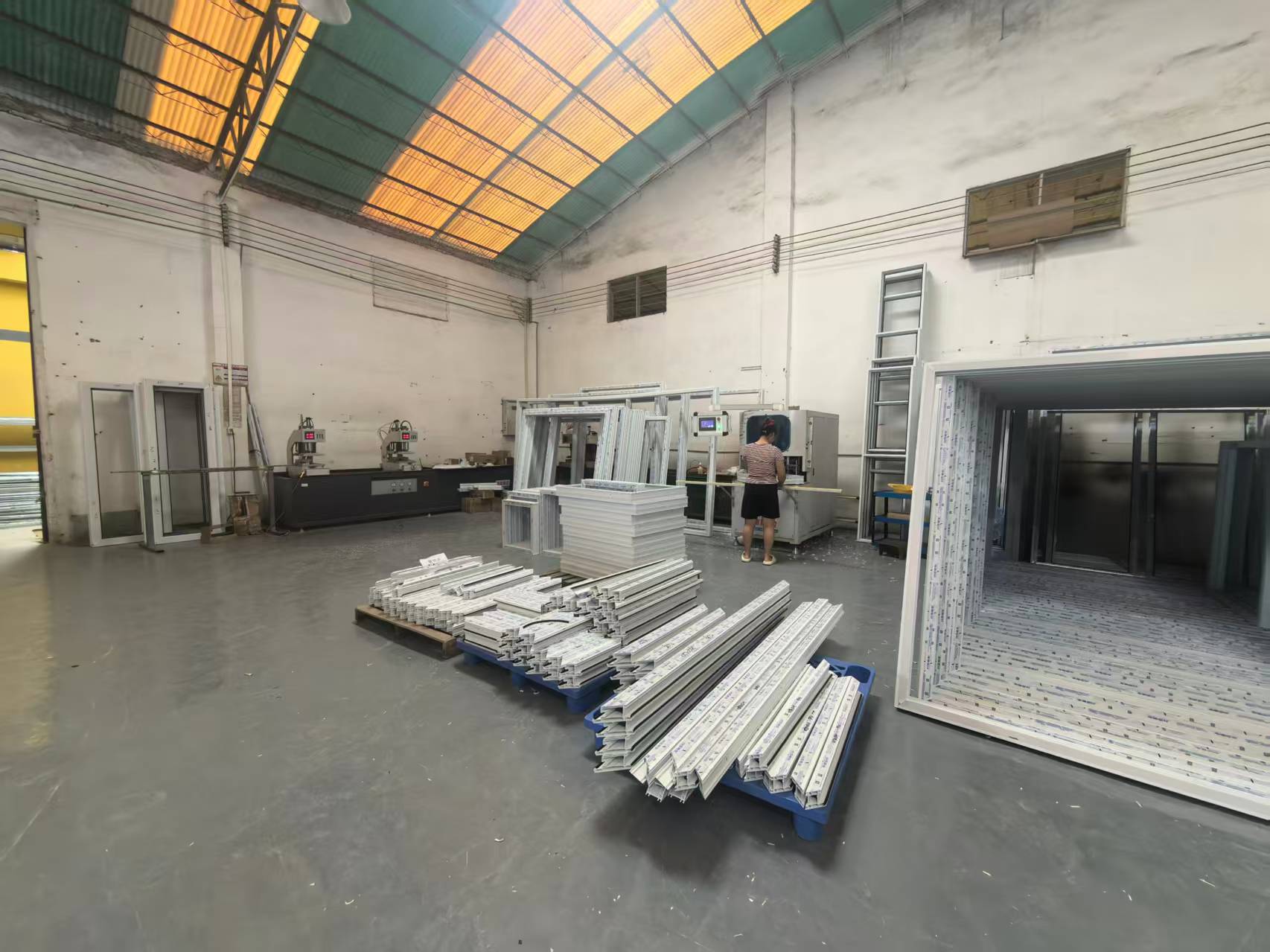
Welding and assembly area. Reinforcement is inserted before welding, which is why it cannot be seen on a finished door.
Questions buyers ask about plastic steel and plastic doors
What does a plastic steel door need to comply with for the EU market?
The requirements referenced for this category are conformity with EN 14351-1:2006+A2:2016, completion of the required system tests for wind resistance, water tightness, air permeability, sound insulation, thermal performance, drop-weight impact and welding corner strength, a factory production control system, a Declaration of Performance, CE marking on the product, and retained test reports and technical documentation. The requirement list applies to the product being supplied, so the declaration should be requested for the specific model and size being quoted.
What is the core difference between a UPVC door and an ordinary plastic door?
The core difference is structural reinforcement. UPVC doors use PVC-U profiles with internal galvanized steel liners that raise strength and wind-pressure resistance. Ordinary plastic doors have no steel reinforcement, which produces low rigidity and a high risk of deformation, and makes them unsuitable for exterior building applications.
Can ordinary plastic doors be used as exterior doors?
No. Without steel liners, a plastic door deforms easily under wind load and is not suitable for exterior or high-rise projects. The documented safety risk is specific: applying a non-reinforced door to an exterior or high-rise opening. If such a door has already been installed and is deforming, the corrective step is replacement with a reinforced door rather than adjustment on site.
Which option is more cost-effective for a real project?
The reinforced UPVC door. It carries a higher initial cost, but the reference material describes it as much more cost-effective for actual projects because of its long service life and stable performance. A pure plastic door is cheap upfront and has a short service life, so the saving is concentrated at purchase and is not maintained over the life of the building.
How do I verify the steel liners before shipment?
Check the technical specification for stated galvanized steel liners and a named profile series, then observe a profile end face to confirm metal inside the cavity. Where liners are missing on goods intended for exterior use, reject them and require replacement with qualified reinforced doors. Keeping this check at pre-shipment stage avoids discovering the problem after the doors are on site.
What should buyers compare between UPVC door manufacturers?
Compare the construction rather than the label: whether galvanized liners are included and how far they run, which profile series is used, which door models and opening types are offered, the declared thermal and acoustic values with the test reports behind them, the hardware set, the colour finishes available, and the factory's capacity and market experience. A supplier with 10 engineers, a 3,000 square metre facility and 50,000 units of annual capacity can answer those questions in writing, and a documented answer is what makes a shortlist defensible. Buyers who want to test a door against their own opening can request a sample and specification sheet before placing a project order — contact details for the factory in this guide are published with its product range.
What to take away
Plastic steel door and UPVC door are two names for the reinforced product; plastic door describes the unreinforced version. The difference is not cosmetic and it is not a marketing tier — it is a galvanized steel liner inside the profile cavity, and it decides whether the door can be used on an exterior or balcony opening at all.
For buyers at the research stage, three actions settle the question. Write reinforcement into the specification, not just the product name. Check the profile end face before shipment. And treat declared performance values as belonging to a named model with a test report, not to the category as a whole. Those three habits will separate a steel-lined door from a plastic one long before the first wind load arrives.
Have Questions or Need More Details?
Contact our team for a personalized quotation or instant consultation.
Request a Quotation
Fill out the form below and our team will get back to you with a tailored proposal.
WhatsApp Direct Chat
Prefer to chat in real-time? Message us on WhatsApp for instant assistance & quick answers.
- Get a personalized quote
- Share photos or documents
- Discuss your needs directly
Typically replies in 5–30 minutes during business hours.