UPVC Door Hardware & Operation Modes: Handles, Hinges and Rollers Technical Guide
UPVC Door Hardware & Operation Modes: Handles, Hinges and Rollers Technical Guide
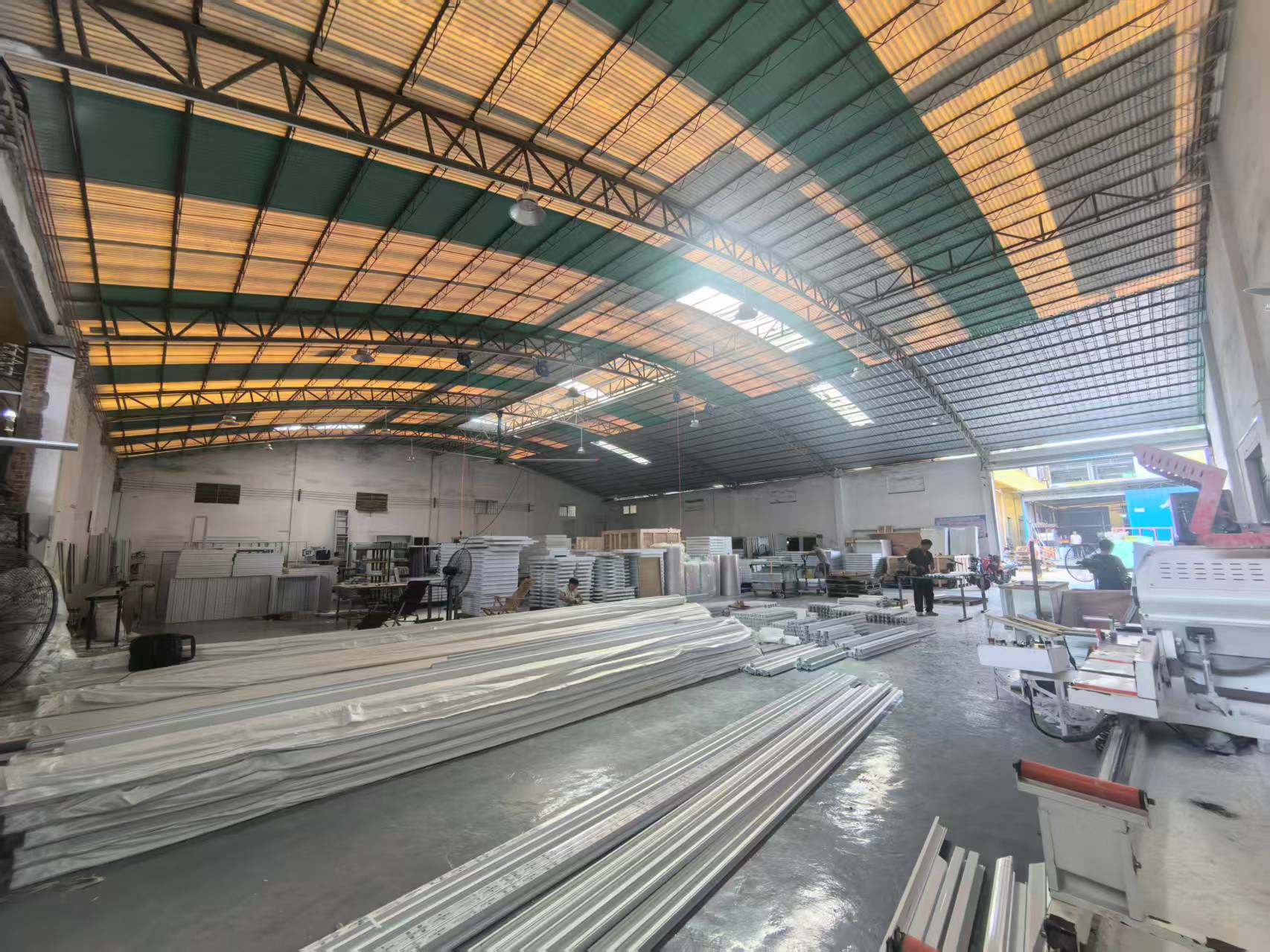
Cover: Material cutting area at Foshan Nanhai Yuanzhaiji UPVC Door & Window Factory — the stage where UPVC door profile components are cut to length before hardware fitting.
A UPVC door is only as good as the hardware that moves it. Handles, hinges and rollers turn a hand movement into controlled sash travel, and they hold the sash in the exact position where the EPDM sealing gasket and the dust-proof pile weatherstrip can compress and seal. Choose the hardware badly and a door with a correct profile and insulated glass will still leak air, lose heat, pass noise, and fail at a hinge or roller long before the profile reaches the end of its service life.
This guide explains what each hardware group does inside a UPVC door, using product 7970 (UPVC Door, models HF60, WYK75-1 and HF88-L) from Foshan Nanhai Yuanzhaiji UPVC Door & Window Factory as the reference example. Foshan Nanhai Yuanzhaiji UPVC Door & Window Factory, established in 2009, is a manufacturer of UPVC doors and windows whose products serve the LATAM, MENA, ASEAN and EU markets. Three operation modes are covered below — sliding, tilt-and-turn, and manual opening and closing — and each is linked to the performance attributes a project team actually tests after installation: sturdiness and durability, easy cleaning, sound insulation, heat insulation, water-tight sealing and wind resistance.
Problem Definition: Why Two Doors With the Same Profile Behave Differently
Two UPVC doors can use the same profile series, the same glass and the same performance claim, and still behave differently in service. The difference almost always sits in the operating layer: the hardware that drives the sash, and the way that hardware is anchored into the profile.
A UPVC door reaches its rated performance only when two conditions are met at the same time. The structural condition is that the PVC-U profile contains internal galvanized steel liners — the liners, not the plastic, carry wind load and sash weight. The mechanical condition is that the hardware pulls the sash against the frame evenly on all four sides every time the door is closed. Ordinary plastic doors have no steel reinforcement, deform easily under load, and are not suitable for exterior or high-rise applications. UPVC plastic-steel doors are the cost-effective choice for actual projects because profile reinforcement and adjustable hardware can work together over a long service life.
Most field complaints about UPVC doors — draughts on the handle side, water tracking in at a bottom corner, a sash that has dropped and scrapes the threshold, noise that appears after two or three seasons — are alignment and compression problems rather than profile problems. They are solved by hardware selection, correct assembly, and a maintenance routine that can be repeated for the life of the door.
Industry Background: A Market Moving Toward Verifiable Assembly Performance
The commercial case for treating hardware as a specification item rather than an accessory comes from the direction the market is moving.
- The global uPVC windows and doors market was valued at USD 30.8 billion in 2025 and is projected to reach USD 32.4 billion in 2026 (Grand View Research).
- Asia Pacific held a 44.1% revenue share of the global uPVC windows and doors market in 2025.
- The doors segment of the uPVC market is expected to grow at a CAGR of 5.3% between 2026 and 2033.
- Sliding configurations accounted for 37.20% of uPVC door and window revenue in 2025 (Mordor Intelligence), which makes roller and track behaviour a mainstream engineering question rather than a niche one.
- In the United Kingdom, the maximum U-value for external doors under the 2025 Future Homes Standard (Approved Document L) is 1.2 W/m²K, reduced from 1.6 W/m²K.
- For classification and customs purposes, plastic doors, windows and their frames and thresholds are covered by HS code 392520.
Two conclusions follow. First, sliding configurations carry a large share of demand, so roller selection and roller adjustment directly affect a large part of the installed base. Second, regulatory thresholds are tightening. A door rated at 1.2 W/m²K cannot hold that rating if a hinge or roller allows air leakage around the sash, because the U-value is measured on the complete assembly, not on the profile in isolation.
Detailed Solution: The Technical Role of Handles, Hinges and Rollers
Handles: the control interface and the locking sequence
The handle is the control interface of the door. Its job is not simply to be gripped — it translates a small, comfortable hand movement into a full locking sequence: the lever rotates the spindle, the spindle drives the gearbox, and the gearbox engages the locking points around the sash.
In a tilt-and-turn door the handle also acts as the mode selector, with defined positions for closed, turn (side-hung) and tilt (bottom-hung) operation. That makes the handle a safety-relevant component as well as a convenience component, because moving the handle while the sash is not in the correct position loads the hinges in a way they were not designed for.
For a buyer, the handle is also the easiest hardware item to assess by hand. What matters is the operating force through the full lever arc, the absence of play between spindle and gearbox, and whether the lever returns to a positive closed position instead of resting half-engaged. A handle that never reaches a firm closed position will never deliver full gasket compression, however good the profile is.
Hinges: the load path and the compression axis
Hinges carry the weight of the sash and define the axis on which the door closes. On a hinged UPVC door, hinge selection sets how the sash load is transferred into the frame, and how much compression the gasket receives on the hinge side when the door is closed.
The critical point is the fixing. A hinge screw holds only as well as the material it is fixed into, which is why the galvanized steel liner inside the PVC-U profile matters: the liner gives the fixing a rigid substrate and keeps the hinge from working loose over thousands of cycles. A heavy sash on a weak fixing drifts downward, the sash loses contact with the gasket at the top corner, and the door begins to leak air and water exactly where the seal is weakest.
Adjustable hinges give installers and maintenance teams a way to restore alignment without replacing the sash. Diurnal movement, thermal cycling and normal wear all shift a door slightly over time; the ability to re-align the sash and re-establish uniform gasket compression is what converts hinge quality into service life.
In UPVC doors the entire hardware layer is anchored into the profile, so the profile material itself sets the working environment. Product 7970 uses a UPVC compound with a Vicat softening point of 86 °C, a flexural modulus of elasticity of 2840 MPa, a tensile yield stress of 43 MPa, a tensile strain at break of 186% and a density of 1520 kg/m³. Those values describe a material with high rigidity and reserve deformation capacity — the combination that allows hardware fixings and steel reinforcement to be carried inside the profile without cracking at the screw line.
Rollers: sash weight, travel and parallel alignment
Rollers carry the sash in sliding and lift-and-slide doors. Their function is to keep a heavy sash travelling parallel to the frame, at a constant height, without binding on the track.
The key mechanical relationship in a sliding door is between roller height adjustment and sealing. If the rollers are set too high, the sash rides above the seal and the door leaks air and water along the bottom edge. If the rollers are set too low, the sash drags, the operating force increases, and both rollers and track wear faster. A correct roller setting places the sash so that the EPDM sealing gasket and the dust-proof pile weatherstrip contact the frame along the full perimeter.
Rollers are also the components most exposed to dust and grit, which is why track cleaning and roller inspection belong in the maintenance plan of any high-cycle sliding installation.
The matched hardware set
UPVC door operation is a system, not a list of parts. The matched hardware set for this door range includes the door handle, door hinge, door roller, anti-collision stopper, dust-proof pile weatherstrip and EPDM sealing gasket. Each element has a defined role:
- Door handle — user control and locking sequence; mode selection on tilt-and-turn doors.
- Door hinge — sash load path, closing axis and hinge-side gasket compression.
- Door roller — sash weight support, travel and parallel alignment in sliding operation.
- Anti-collision stopper — limits sash travel and protects the frame and hardware at the end of the opening stroke.
- Dust-proof pile weatherstrip — brushes out fine dust and reduces air infiltration along sliding tracks.
- EPDM sealing gasket — the primary compression seal that converts a correctly aligned sash into water-tight and air-tight performance.
Operation mode 1: sliding
Sliding operation moves the sash horizontally. The handle engages the lock, and the rollers carry the sash. Because the sash does not swing, the compression seal depends on roller setting and on the weatherstrip, while the anti-collision stopper prevents the sash from over-running the frame. Sliding operation is the mode where roller adjustment has the greatest effect on water-tight sealing — and it is the mode with the largest market share, since sliding configurations accounted for 37.20% of uPVC door and window revenue in 2025.
Lift-and-slide doors apply the same principle with an added lifting step at the start of the movement. The lifting action reduces friction during opening and closing, which allows larger and heavier sashes to be operated by hand.
Operation mode 2: tilt-and-turn
Tilt-and-turn operation gives a single sash two functions. In the turn position the door opens at the side, like a casement door, on the hinges. In the tilt position the sash tilts inward from the bottom while the top edge stays close to the frame. The handle selects the mode, and the hinge geometry controls the load in each position.
For a buyer, tilt-and-turn operation is the mode that depends most heavily on hinge adjustment, because the sash must return to a precise closed position for the gasket to compress evenly around the perimeter. It is also the mode where operating discipline matters most: the sash should be fully closed before the handle is moved between positions.
Operation mode 3: manual opening and closing
Manual opening and closing covers the conventional hinged and European-style door series, including casement and French configurations, where the user pushes or pulls the sash through an arc. In this mode the hinge pair carries the full sash weight, the handle drives the locking points, and the gasket is compressed along the closing edge by the leverage of the handle and the geometry of the frame.
Because the entire sealing force is generated by the hinge and lock interaction, hardware wear in this mode shows up first as a slight increase in closing effort and later as a visible gap at the top corner of the sash. Both symptoms are alignment signals, not profile failures.
How hardware selection maps to seven performance requirements
| Performance requirement | Hardware dependency | Practical verification point |
|---|---|---|
| Sturdiness | Hinges transfer sash weight into the frame; fixings must land in reinforced profile | Profile end face confirms galvanized steel liners inside the cavities; hinge fixings tighten without play |
| Durability | Hardware cycles, sealing-part life and anti-ageing behaviour of the assembly | Simple hardware maintenance schedule; longer service life of sealing parts; no anti-corrosion spraying required |
| Easy cleaning | Accessible track, smooth handle surfaces and sash travel that clears the frame without tools | Roller height allows the sash to move clear; track and weatherstrip can be cleaned in place |
| Sound insulation | Continuous gasket compression forms the acoustic seal line | Uniform gasket contact along all four edges when the door is closed |
| Heat insulation | Sealed air boundary depends on the sash being held against the gasket; leakage undermines the rated U-value | UK external door threshold under the 2025 Future Homes Standard is 1.2 W/m²K; check for gaps at corners |
| Water-tight sealing | Anti-collision stopper, dust-proof pile weatherstrip and EPDM gasket work together with correct roller height | Roller setting keeps the sash parallel to the frame at the bottom edge |
| Wind resistance | Steel liners and hardware fixings share wind load; locking points hold the sash against pressure | EN 14351-1:2006+A2:2016 wind resistance test result for the complete assembly |
Table: Hardware dependency behind each performance requirement for UPVC door operation.
Step-by-Step Breakdown: Specifying Hardware Before Production
- Define the operation mode first. Decide whether the door will be sliding, tilt-and-turn, or manual opening and closing before any hardware is quoted. The mode determines which parts exist in the assembly at all: rollers and anti-collision stoppers for sliding, mode-selecting handles and adjustable hinges for tilt-and-turn, hinge pairs and locking points for hinged doors.
- Confirm profile reinforcement. Check the technical specification and observe the profile end face to confirm that galvanized steel liners are installed inside the PVC-U cavities. Reject goods without steel liners for exterior doors.
- Fix the matched hardware list in the written specification. Name the door handle, door hinge, door roller, anti-collision stopper, dust-proof pile weatherstrip and EPDM sealing gasket individually, so that later orders and maintenance purchases reference exactly the same set.
- Match hardware to sash weight and door size. Hinge capacity, roller capacity and the number of locking points should be selected against the real sash weight and the intended cycle frequency, not against the smallest configuration available.
- Verify the complete assembly, not the parts. Under EN 14351-1:2006+A2:2016, the required system tests cover wind resistance, water tightness, air permeability, sound insulation, thermal performance, drop-weight impact and welding corner strength. The manufacturer is also expected to operate a factory production control (FPC) system, issue a Declaration of Performance (DoP), apply CE marking, and keep test reports and technical documentation available for inspection. This is where technical consultancy from the factory matters: hardware questions should be answered against test evidence for the same assembly being ordered.
- Agree the commercial and acceptance terms before production. For UPVC doors, MOQ is 30–40 ㎡, delivery terms are FOB or CIF, and payment is by bank transfer. Acceptance can be arranged through pre-shipment inspection via photos or on-site inspection.
- Inspect the shipment against the hardware list. Pre-shipment inspection is the point at which the handle, hinge and roller set specified in step 3 is confirmed as actually fitted, and the point at which loading is documented.
- Plan the maintenance and spare-parts routine for the service life. Re-align hinges, re-set roller height and replace gaskets or weatherstrips on a fixed schedule. Hardware that can be adjusted and replaced individually is what keeps a door performing in year five as it did in year one.
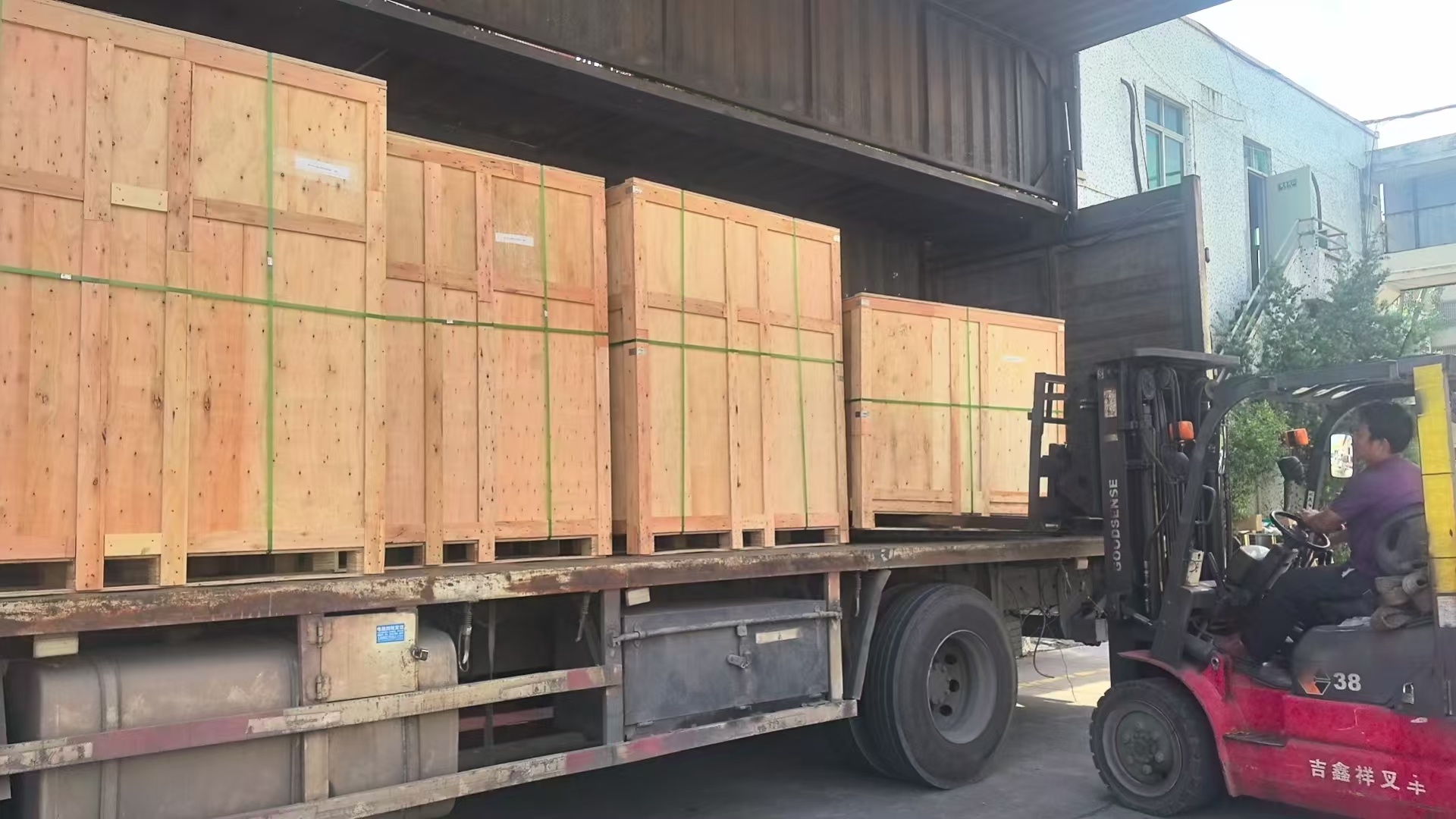
Pre-shipment stage: goods being loaded for shipment, the point where the agreed hardware set is confirmed before delivery.
Use Cases: Where Hardware Choice Decides the Outcome
Coastal, high-humidity and strong-wind installations
Doors installed outdoors in coastal high-humidity, strong-wind areas face a combination of wind pressure, salt exposure and constant moisture. The reinforced UPVC build is positioned for seaside and city applications, with enhanced structural rigidity, corrosion resistance, and no anti-corrosion spraying required, and with simple hardware maintenance over the service life.
Residential buildings and villa projects
In residential building and villa project work, the daily user experience depends on the handle effort, on how easily the sash can be cleaned, and on whether noise from the street is kept out. All three are hardware-dependent: a lightly operating handle, a track that can be cleaned without dismantling, and hinges that hold the gasket closed along its full length.
Commercial buildings and renovation projects
Commercial building and renovation project doors run at a high cycle frequency. Here the maintenance logic dominates: hardware that can be re-adjusted and replaced, and a specification that fixes the same parts list for the whole site, reduces downtime and avoids mismatched replacements later.
EU-market projects with performance thresholds
Projects delivered into the EU market are checked against the EN 14351-1:2006+A2:2016 test package, and UK external doors against the 1.2 W/m²K maximum U-value under the 2025 Future Homes Standard. Because these values are measured on the complete assembly, hardware that prevents full gasket compression is a compliance risk, not only a comfort issue.
Distributor programmes with repeat orders
For distributors running a multi-year programme, the same hardware list must be reproducible order after order. Foshan Nanhai Yuanzhaiji UPVC Door & Window Factory states that it adheres to reliable quality, reasonable pricing and on-time delivery, and it is equipped to undertake large-scale domestic and overseas projects. Approximately 80% of its products are exported, export business accounts for 80% of total sales, and its major markets are LATAM, MENA, ASEAN and the EU — a distribution footprint that makes repeatable specifications more important than one-off pricing.
Comparison: Reinforced UPVC Door Build vs Conventional Standard Build
The table below reflects the factory's own comparison between its reinforced UPVC door build and a conventional standard UPVC door. It is included because hardware performance cannot be separated from the profile that holds it: hinge and roller behaviour depends on the rigidity of the material and the reinforcement behind the fixing.
| Parameter | Conventional standard UPVC door | Reinforced UPVC door build |
|---|---|---|
| Profile wall thickness | Conventional wall thickness | 2.0–3.0 mm thicker than the conventional version |
| Structural rigidity | Standard rigidity | Enhanced structural rigidity |
| Best-fit environments | General use | Seaside / city |
| Initial procurement cost | Baseline | 12–18% higher initial procurement cost |
| Total life-cycle cost | Higher over the service life | Lower total life-cycle cost |
| Maintenance profile | Standard maintenance | Simple hardware maintenance; longer service life of sealing parts; better anti-ageing property; no anti-corrosion spraying required |
| Sealing and environmental performance | Baseline performance | Thermal insulation, sound insulation, wind and rain resistance, corrosion resistance and good sealing performance |
Table: Factory comparison of the reinforced UPVC door build against a conventional standard UPVC door.
FAQ
Which standard applies to UPVC door performance in the EU market, and does it cover hardware?
Complete UPVC door assemblies supplied to the EU market are referenced against EN 14351-1:2006+A2:2016 for windows and doors. The standard calls for system tests covering wind resistance, water tightness, air permeability, sound insulation, thermal performance, drop-weight impact and welding corner strength, together with a factory production control (FPC) system, a Declaration of Performance (DoP) and CE marking on the product; test reports and technical documentation are kept for inspection. Hardware is not approved in isolation — handle, hinge and roller behaviour directly affects the wind resistance, water tightness and air permeability results of the complete assembly. In the United Kingdom, external doors are additionally driven by a maximum U-value of 1.2 W/m²K under the 2025 Future Homes Standard (Approved Document L), reduced from 1.6 W/m²K.
How can I confirm that hinges and rollers are anchored into reinforced material rather than into plastic alone?
Inspect the profile end face. UPVC doors use PVC-U profiles with internal galvanized steel liners, and the liners provide the rigidity and wind-pressure resistance that hardware fixings rely on. The practical acceptance route is: check the technical specification first, then observe the profile end to confirm that steel liners are installed inside the cavities, and reject goods without steel liners for exterior doors. Ordinary plastic doors have no steel reinforcement and deform under load, so they are not suitable for exterior or high-rise applications.
What are the ordering terms — MOQ, delivery and payment?
For UPVC doors, MOQ is 30–40 ㎡. Delivery terms are FOB or CIF, and payment is by bank transfer. Acceptance can be arranged through pre-shipment inspection via photos or on-site inspection. For UPVC Door models HF60, WYK75-1 and HF88-L, FOB and CIF terms are available, and delivery to overseas project sites is arranged through FOB or CIF methods.
Can a buyer evaluate the door and its hardware before committing to a production order?
A sample showroom is available for one-stop purchasing service, and the factory is equipped to undertake large-scale domestic and overseas projects. Sampling is the practical way to check handle operating force, hinge adjustment range, roller travel and gasket compression before the specification is frozen. Quality verification of the finished goods can then be carried out through pre-shipment inspection, either by photo or on site.
How does a distributor keep a long-term UPVC door supply line stable, including spare parts?
Long-term supply depends on a specification that does not change between orders and on a supplier that states its delivery commitments clearly. Foshan Nanhai Yuanzhaiji UPVC Door & Window Factory states that it adheres to reliable quality, reasonable pricing and on-time delivery, and it is equipped to undertake large-scale domestic and overseas projects. Approximately 80% of its products are exported, export business accounts for 80% of total sales, its major markets are LATAM, MENA, ASEAN and the EU, and payment for long-term or repeat UPVC door supply orders is settled by bank transfer. For hardware specifically, lock the operation mode and the matched parts list — door handle, door hinge, door roller, anti-collision stopper, dust-proof pile weatherstrip and EPDM sealing gasket — into the original purchase specification, so that every repeat order references the same hardware set. A short technical consultation on the opening and closing sequence before the first order is the simplest way to avoid a mismatched spares list later; the factory team can be reached through yuanzhaiji.com.
Conclusion
UPVC door performance is delivered at the point where hardware meets profile. Handles generate the locking force, hinges carry the sash and hold the gasket closed, and rollers keep a heavy sash parallel to the frame so that the EPDM sealing gasket and dust-proof pile weatherstrip can do their work. Sturdiness, durability, easy cleaning, sound insulation, heat insulation, water-tight sealing and wind resistance all trace back to those three hardware groups and to the galvanized steel liners that anchor them.
For a project buyer or distributor planning a multi-year programme, the decision sequence is straightforward: fix the operation mode, confirm reinforcement inside the profile, specify the full matched hardware set, verify through the EN 14351-1:2006+A2:2016 test package and pre-shipment inspection, and set a maintenance and spares routine that keeps the seal working for the life of the door.
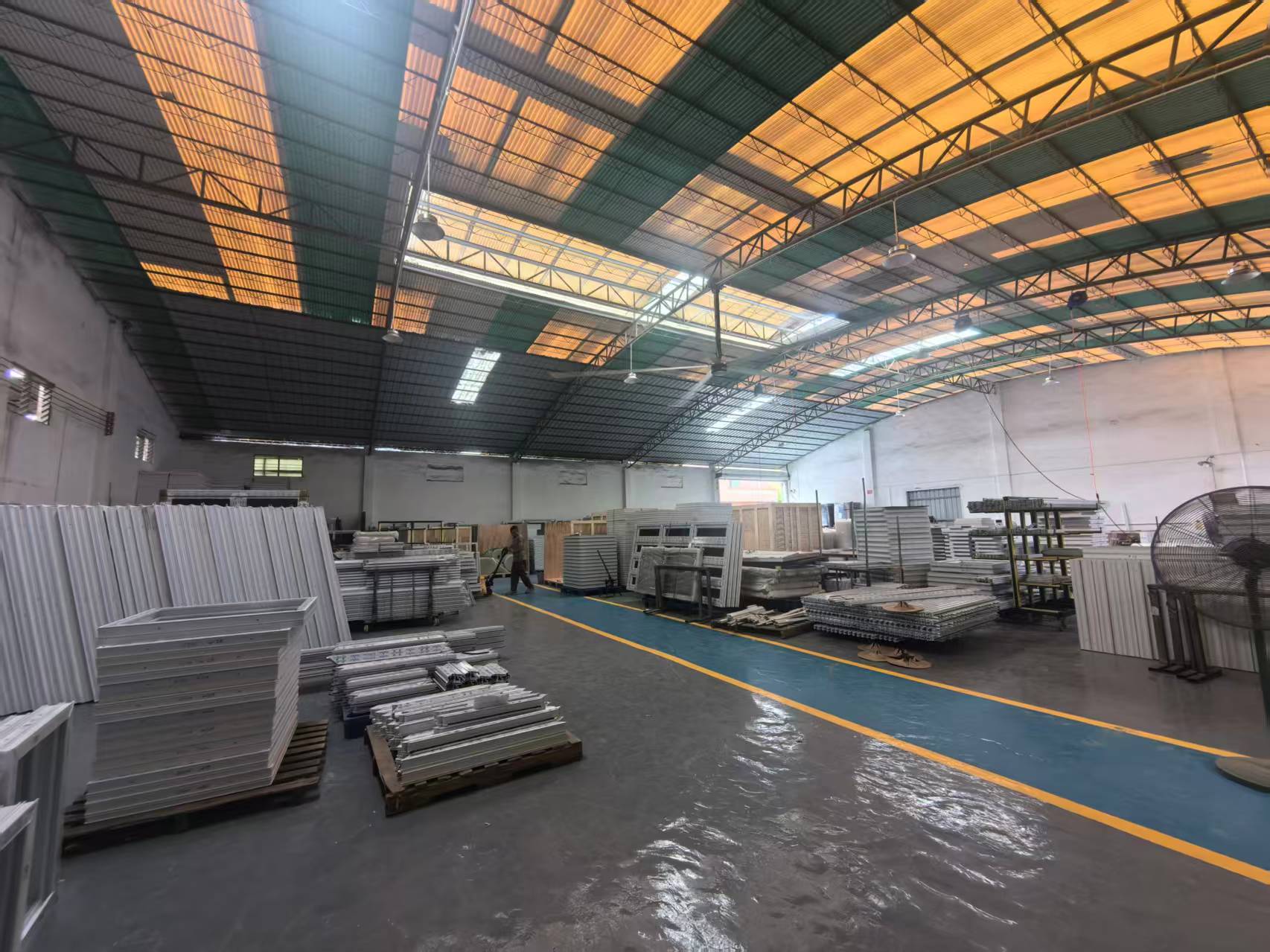
Goods storage area: finished UPVC doors and windows staged for shipment.
Next step for project and distribution buyers
Foshan Nanhai Yuanzhaiji UPVC Door & Window Factory supplies UPVC doors and windows to LATAM, MENA, ASEAN and the EU. A sample showroom is available for one-stop purchasing service. MOQ 30–40 ㎡ · FOB / CIF · bank transfer · pre-shipment inspection by photo or on site.
Contact: YUAN · Email: 1803877678@qq.com · Tel / WhatsApp: +86 130-0674-7018 · Website: yuanzhaiji.com · Blog: blog.yuanzhaiji.com
Have Questions or Need More Details?
Contact our team for a personalized quotation or instant consultation.
Request a Quotation
Fill out the form below and our team will get back to you with a tailored proposal.
WhatsApp Direct Chat
Prefer to chat in real-time? Message us on WhatsApp for instant assistance & quick answers.
- Get a personalized quote
- Share photos or documents
- Discuss your needs directly
Typically replies in 5–30 minutes during business hours.