UPVC Door Compliance Checklist: Certification, Material Data & Thermal Specs
UPVC Door Compliance Checklist: Certification, Material Data & Thermal Specs
A UPVC door that arrives on a project site is judged on three documented constraints long before anyone looks at the finish: the scope of the certification attached to the product, the measured data behind the profile, and the performance target set by the destination market. When one of the three does not line up, the door itself can be perfectly manufactured and still fail inspection, fail tender approval, or fail the buyer's own compliance review.
This checklist is written for importers, distributors, contractors and project buyers who are comparing China UPVC door manufacturers and need to separate verifiable documents from sales language. It uses the published product and certification record of Foshan Nanhai Yuanzhaiji UPVC Door & Window Factory (Yuanzhaiji), a UPVC door and window manufacturer established in 2009 that exports around 80% of its output to LATAM, MENA, ASEAN and EU markets, as a worked example of what a complete specification file contains.
Quick answer. A UPVC door is a door fabricated from unplasticized polyvinyl chloride (UPVC / PVC-U) profiles, reinforced internally with galvanized steel liners. For Yuanzhaiji door models HF60, WYK75-1 and HF88-L, the recorded material data is density 1520 kg/m³, Vicat softening point 86 °C, flexural modulus of elasticity 2840 MPa, tensile yield stress 43 MPa and tensile strain at break 186%. The factory's attestation under EN 14351-1:2006+A2:2016 is a voluntary ECM Attestation intended for third countries outside the EU market — it is not a CE marking for placing product on the EU market.
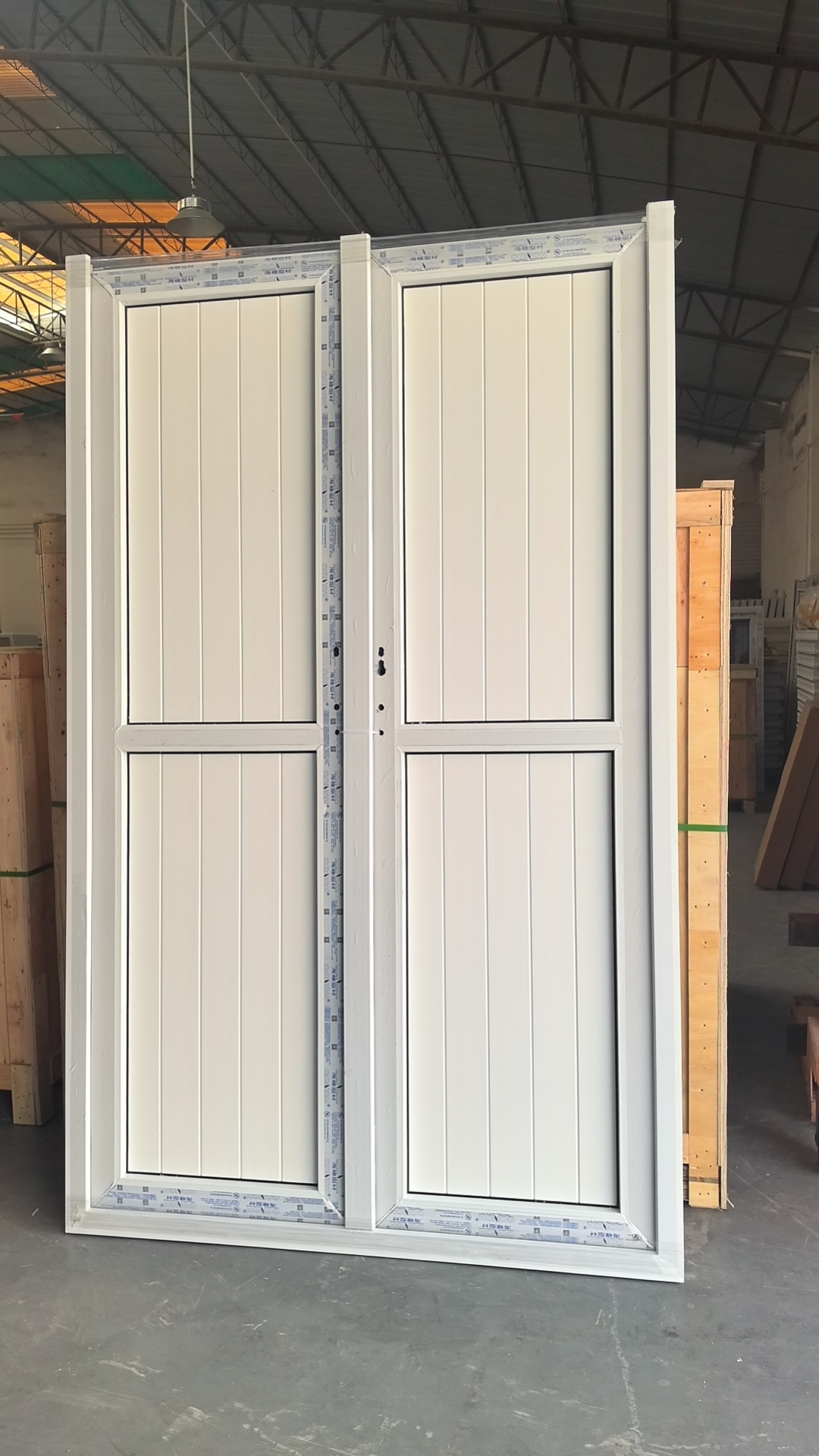
Cover: UPVC 60-series full vertical-panel French casement door from the Yuanzhaiji door range.
Why UPVC Door Specifications Break Down Before Production Starts
Three failure points recur in UPVC door procurement, and all three are documentation problems rather than manufacturing problems.
Certification scope drift. A certificate is written against a defined product scope. The Yuanzhaiji ECM Attestation, for example, covers UPVC Windows and Doors, Profiles Series 50/60/65/80/88/112. A buyer who orders a configuration outside that series range — or who reads the document as a general company certificate rather than a product-scope document — discovers the mismatch only at inspection. The same document states that it is a voluntary certification applied for the non-EU market, which means it serves a different purpose than EU placing-on-market documentation.
Parameter opacity. Thermal insulation and sound insulation appear as adjectives in most supplier brochures, with no measured values behind them. In the Yuanzhaiji product record, sound insulation and heat insulation are listed characteristics of the door system, and they sit alongside a published set of material parameters rather than replacing them. That difference decides whether a buyer can compare two suppliers on the same basis.
Structural class confusion. The most expensive error is ordering a non-reinforced door for an exterior opening. UPVC doors adopt PVC-U profiles with internal galvanized steel liners for reinforcement, which is what gives them strength and wind-pressure resistance. Ordinary plastic doors have no steel reinforcement: they are low-cost but deform easily, are not fit for exterior usage, and must not be used for outdoor or high-rise exterior scenarios. That distinction belongs in the specification, not in the post-installation complaint file.
The practical consequence is that a UPVC door enquiry should carry three attachments before price is discussed: the certificate and its scope, the material data sheet, and the performance target for the destination market.
What the 2025–2026 UPVC Door Market Data Says About Tightening Constraints
The commercial reason these three checks matter is that the volume side of the market keeps growing while the acceptance side keeps tightening.
- The global uPVC windows and doors market was valued at USD 30.8 billion in 2025 and is projected to reach USD 32.4 billion by 2026 (Grand View Research, uPVC Windows & Doors Market Size | Industry Report, 2033).
- Asia Pacific held a 44.1% revenue share of that market in 2025, which is why most specification and compliance questions in the category originate from Asian supply (Grand View Research).
- The doors segment is expected to grow at a CAGR of 5.3% from 2026 to 2033 (Grand View Research).
- Sliding configurations accounted for 37.20% of uPVC door and window revenue in 2025 (Mordor Intelligence, UPVC Doors and Windows Market Share & Trends, Size 2031).
- Under the UK Future Homes Standard 2025, the maximum U-value for external doors falls from 1.6 W/m²K to 1.2 W/m²K (Approved Document L / Future Homes Standard guidance).
- Plastic doors, windows and their frames and thresholds are classified under HS code 392520 (USITC / WCO Harmonized Tariff Schedule) — the code buyers and freight forwarders should expect on the commercial invoice.
Read together, these figures describe a market where demand is stable but acceptance thresholds are rising. A 1.2 W/m²K external door limit in one market is a specification constraint, not a marketing claim, and it can only be met by controlling glass build-up, profile chamber design and sealing detail — all of which sit behind the material data a supplier is able to publish.
The sliding share figure carries a similar message. If more than a third of category revenue is sliding product, then roller quality, track alignment, pile weatherstrip and gasket specification become the difference between a door that passes a water-tightness check and one that does not. Those are components with part numbers, not adjectives.
Middle East, North Africa and Southeast Asian project markets add a second layer of constraint that European averages do not capture: outdoor, coastal high-humidity and strong-wind working conditions, where wind-pressure resistance, water tightness and air permeability, impact and wear resistance, a secure locking system, and weather-resistant, anti-aging behaviour matter as much as thermal numbers.
What Yuanzhaiji's UPVC Door Record Actually Documents
Yuanzhaiji is a UPVC door and window manufacturer established in 2009, operating with OEM/ODM and customization capability that covers door size, specification and glass specification. The point of reviewing its file here is not the brand name; it is the structure of the file, which is what any buyer should be able to obtain from any serious supplier.
The certification file
The attestation on file for the UPVC Door is an ECM Attestation, certificate number NO.3N230816.YCPQQ51, issued by Ente Certificazione Macchine Srl (ECM). The applicable standard is EN 14351-1:2006+A2:2016. It is a voluntary certification for the UPVC Door, it was issued on 2023-08-16, and it expires on 2028-08-15. The certification scope covers UPVC Windows and Doors, Profiles Series 50/60/65/80/88/112, and it is intended for third countries outside the EU market.
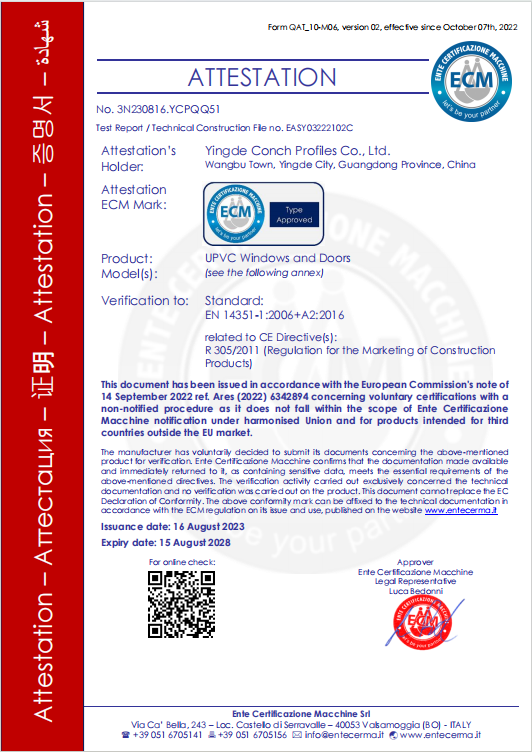
ECM Attestation NO.3N230816.YCPQQ51, issued by Ente Certificazione Macchine Srl (ECM) under EN 14351-1:2006+A2:2016.
Three things follow from reading the document precisely rather than skimming it. First, the scope is defined by profile series, so a purchase order should name the series in use. Second, the standard cited is the European product standard for windows and pedestrian doorsets, which gives the attestation technical weight even though the document is aimed at third-country markets. Third, because it is voluntary and intended for third countries outside the EU, a buyer planning to place product on the EU market should confirm the applicable route with their importer instead of treating the word CE as a synonym for any certificate.
Material parameters
The following values are recorded for the UPVC material used in door models HF60, WYK75-1 and HF88-L:
- Density: 1520 kg/m³
- Vicat softening point: 86 °C
- Flexural modulus of elasticity: 2840 MPa
- Tensile yield stress: 43 MPa
- Tensile strain at break: 186%
These are standard material-property measurements rather than performance promises, and that is exactly why they belong in a specification. Density describes how the compound is formulated. A Vicat softening point of 86 °C indicates the temperature at which the material begins to soften under a defined test load — relevant information in hot, high-radiation markets. Flexural modulus of elasticity describes stiffness under bending, which feeds directly into the wind-load discussion. Tensile yield stress identifies the point at which the material starts to yield instead of recovering, and a tensile strain at break of 186% describes how far the material elongates before failure. A buyer who requests these five values can compare suppliers on one basis; a buyer who accepts a phrase like high quality cannot.
Product range and profile supply
Documented door configurations include a 60-series fully-glazed casement door, plus full horizontal-panel and full vertical-panel casement variants, and a 112/88-series sliding door supplied with a fly screen. The range also covers lift-and-slide doors and hinged doors alongside the factory's European and American style door series. On the profile side, the factory long-term supplies Conch profiles in 60/65/88 series, available in co-extruded color, laminated wood-grain finish and solid colors such as dark grey and black.
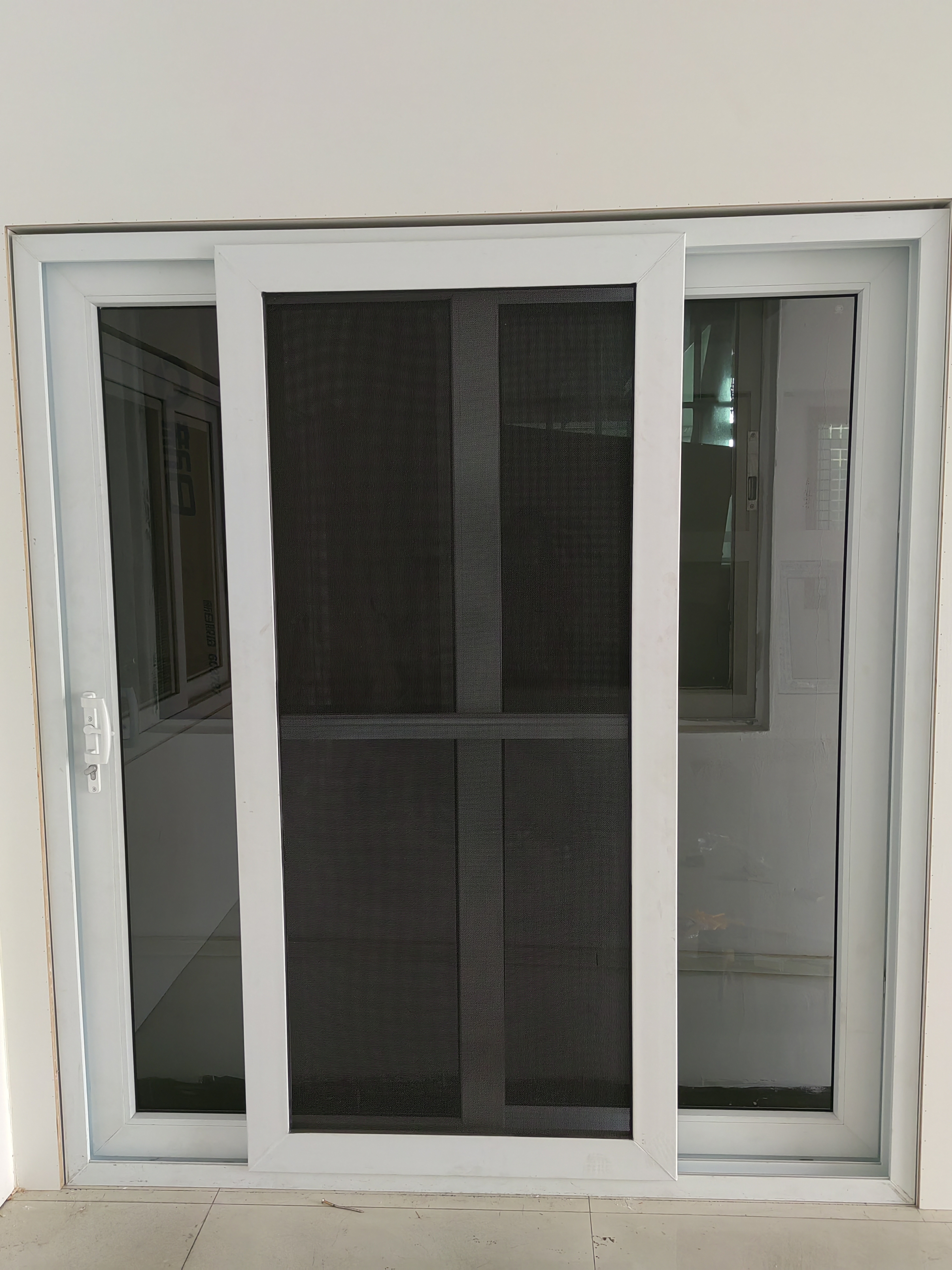
UPVC 112/88-series sliding door with fly screen — the sliding configuration accounts for 37.20% of uPVC door and window revenue in 2025 (Mordor Intelligence).
Manufacturing capability, MOQ and commercial terms
Recorded capability: monthly capacity 4,000 ㎡; production mode OEM/ODM/customizable; lead time 10–30 days; MOQ 30–40 ㎡; export markets EU, Africa and USA. Quality control is supported by a Quality Inspection Report, and after-sales support covers technical consultancy and quality testing. A sample showroom is available for one-stop purchasing.
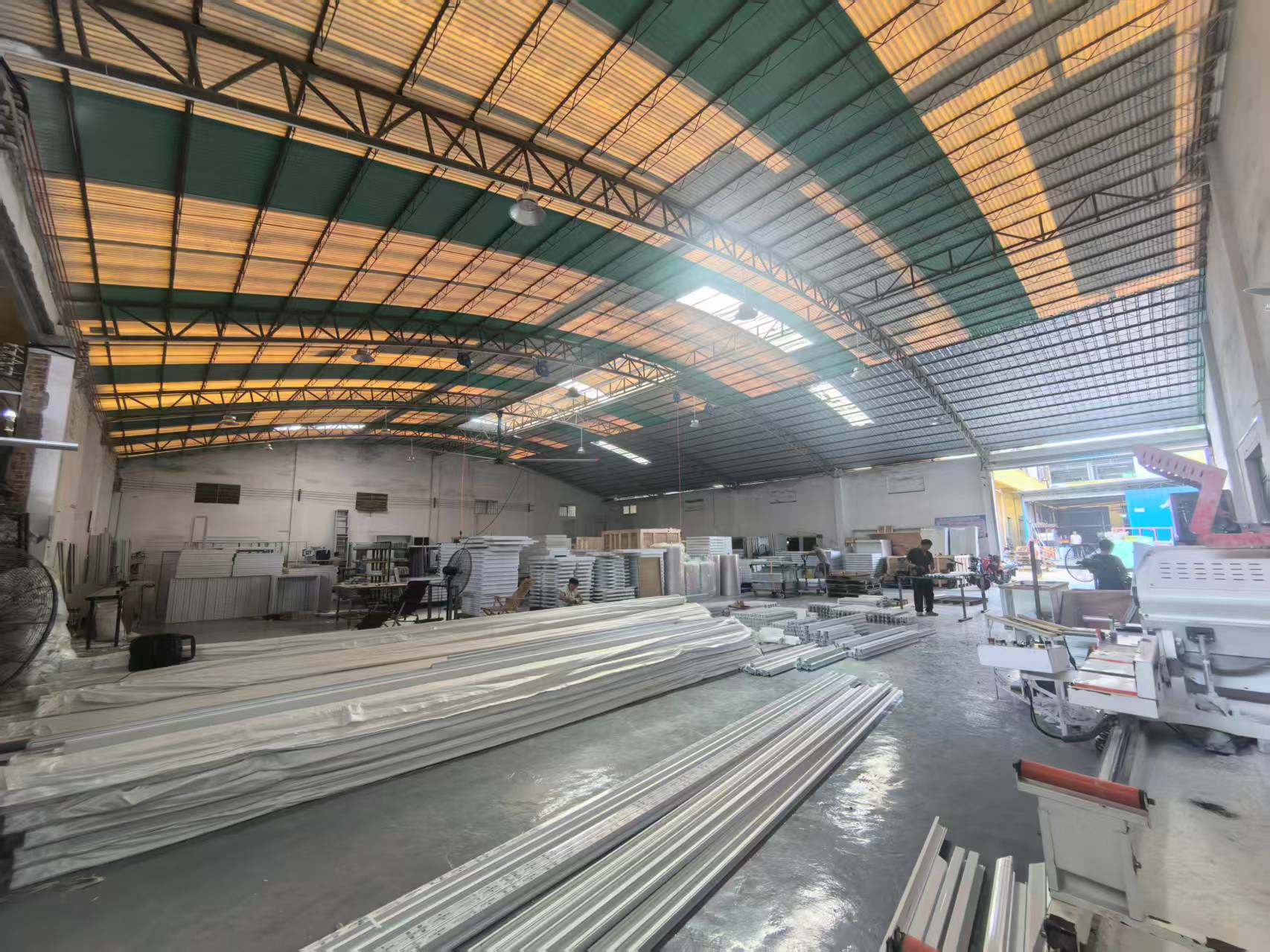
Material cutting area: profile preparation is where the series and wall construction named in the purchase order first become visible.
How to Verify a UPVC Door Specification, Step by Step
The sequence below is written so that each step removes one source of dispute before the next one is discussed.
Step 1 — Fix the performance target before contacting suppliers. Write the destination market's requirements into the enquiry: wind-pressure resistance, water tightness and air permeability, impact and wear resistance, secure locking, weather-resistant and anti-aging behaviour, and the local building access standard that applies. If the market sets a numeric threshold, state it — for example, the UK Future Homes Standard 2025 limit of 1.2 W/m²K for external doors, down from 1.6 W/m²K.
Step 2 — Ask which standard and which certification route applies. Request the standard number, certificate number, issuing body and expiry date, and ask whether the scheme is mandatory or voluntary for your market. A supplier who answers this question precisely has the document; a supplier who answers with the word CE has a talking point.
Step 3 — Match the certificate scope to the ordered profile series. The Yuanzhaiji attestation covers profile series 50/60/65/80/88/112. If the order uses a series outside that list, the certificate does not cover the door, regardless of what the front page says.
Step 4 — Request the material data and the Quality Inspection Report. Five values are enough to make the profile comparable: density, Vicat softening point, flexural modulus of elasticity, tensile yield stress and tensile strain at break.
Step 5 — Confirm hardware and sealing components as line items. The matched equipment recorded for these door projects is a door handle, door hinge, door roller, anti-collision stopper, dust-proof pile weatherstrip and EPDM sealing gasket. Components are where weather resistance and noise reduction are actually delivered, so they should appear in the quotation rather than in a footnote.
Step 6 — Validate with a sample before mass production. A sample showroom is available, and with an MOQ of 30–40 ㎡ a validation order can stay small. At acceptance, check the profile end face to confirm that the galvanized steel liners are present inside the cavities — this is the single check that separates a UPVC door from an unreinforced plastic door.
Step 7 — Lock lead time and the shipment document set. Recorded lead time is 10–30 days. Before booking freight, confirm the Quality Inspection Report, the certification copy, and that the commercial invoice carries HS code 392520 for plastic doors, windows and their frames and thresholds.
Where These UPVC Door Configurations Fit
The recorded working conditions for Yuanzhaiji door projects are outdoor, coastal high-humidity and strong-wind areas, across residential buildings, commercial buildings, renovation projects and villa projects. Recorded operation modes are manual opening and closing, tilt-and-turn opening and sliding operation.
- Sliding doors with fly screen: the 112/88-series sliding door with fly screen suits openings where insects, dust and street debris are a daily issue, and where the door will be operated many times a day. Sliding operation removes swing clearance from the design.
- Fully-glazed and panel casement doors: the 60-series range covers a fully-glazed configuration and full horizontal-panel or full vertical-panel variants, which is useful when a facade needs to hold one visual language across different opening types.
- Bathroom and wet interior zones: the 75-series bathroom door with tall upper glass and bottom louver is the configuration to specify where a wet room needs light transfer at the top and ventilation at the base.
- Coastal and high-wind openings: these are the situations where the steel-liner question and the hardware-set question are decided, because wind-pressure resistance and water tightness depend on reinforcement, roller alignment, pile weatherstrip and gasket quality together.
- Renovation and villa projects: customization covers door size, specification and glass specification, which matters when an existing opening does not match a standard size.
A recorded case. A builder client project in Bahrain covering 500 ㎡ of architectural UPVC door and window supply is recorded with a duration of 10 years. The reported results are stable sealing performance, smooth switch operation and long-term service life. The listed highlights are high-quality profiles, corrosion-resistant hardware, safe tempered glass, fine workmanship, low-noise sliding, water-proof and dust-proof performance, a simple and attractive appearance, and easy maintenance. Read as evidence rather than as a slogan, the case supports one specific claim: that sealing performance and switching smoothness held up over a ten-year service window in a hot coastal environment, which is exactly the environment where hardware and gasket specification are stress-tested.
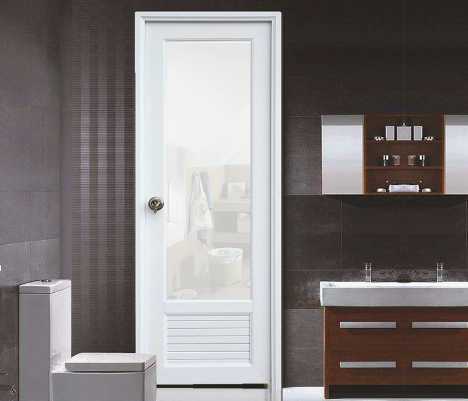
75-series UPVC bathroom door with tall upper glass and bottom louver — a configuration specified for wet interior zones where ventilation and light transfer are both required.
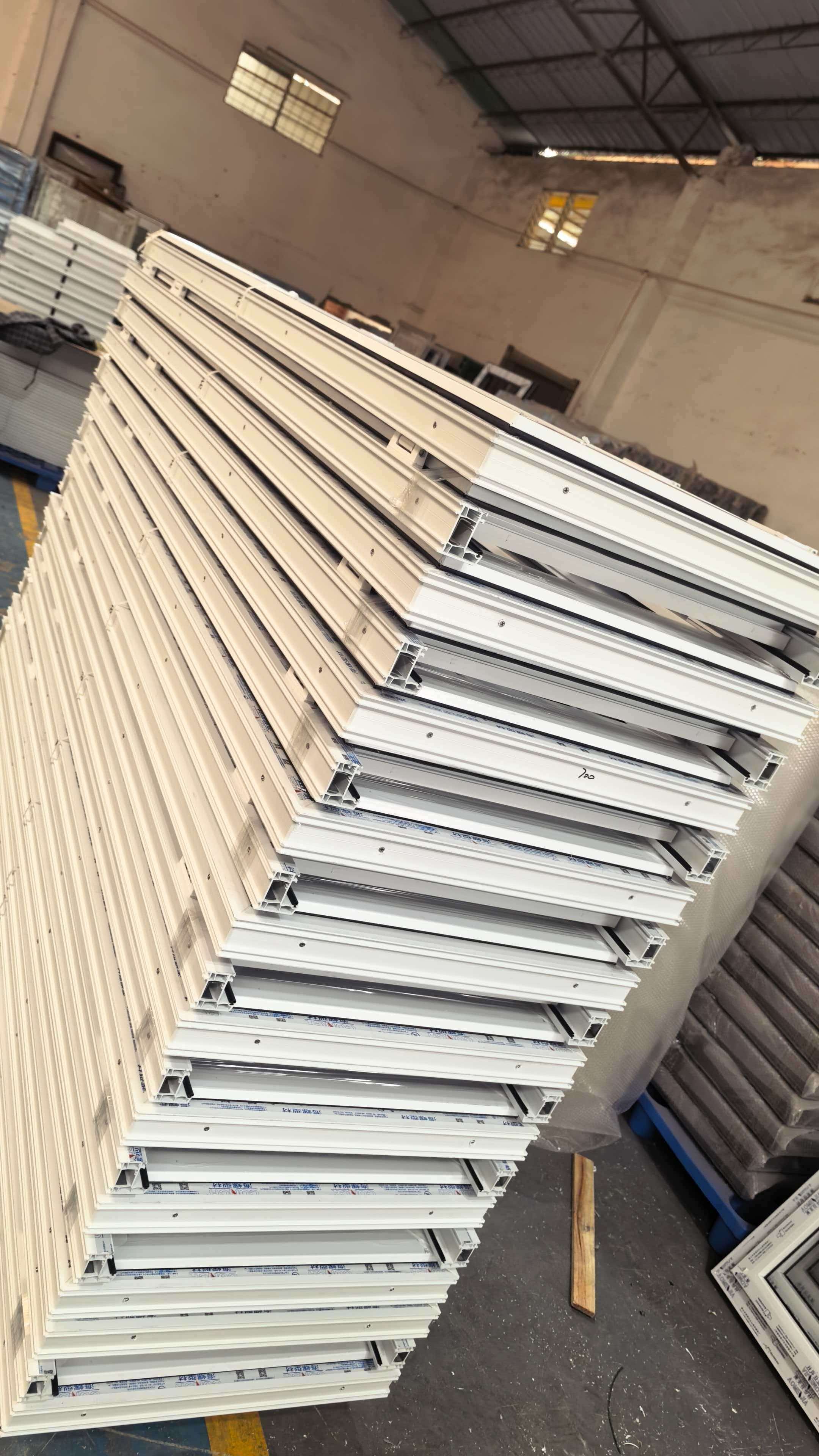
Fully-fabricated UPVC casement door from the project supply recorded for a builder client in Bahrain.
UPVC Door Comparison: Configurations and Structural Classes
The first table lists the door configurations documented in the product record, so a buyer can map an opening schedule to what is actually manufactured rather than to a generic category name. The second table draws the line that causes the most trouble in exterior applications.
| Documented configuration | Series / model evidence | Operation mode recorded |
|---|---|---|
| Fully-glazed casement door | 60-series; material data recorded for models HF60, WYK75-1, HF88-L | Manual opening and closing |
| Full horizontal-panel casement door | 60-series | Manual opening and closing |
| Full vertical-panel French casement door | 60-series | Manual opening and closing |
| Sliding door with fly screen | 112/88-series | Sliding operation |
| Bathroom door with tall upper glass and bottom louver | 75-series | Manual opening and closing |
| Lift-and-slide door | Door range statement | Sliding operation |
| Hinged door | Door range statement | Manual opening and closing |
Profile supply behind these configurations: Conch profiles in 60/65/88 series, in co-extruded color, laminated wood-grain finish and solid colors including dark grey and black.
| Comparison criterion | UPVC door (steel-lined) | Ordinary plastic door |
|---|---|---|
| Core structure | PVC-U profile with internal galvanized steel liner for reinforcement | Plastic profile with no steel reinforcement |
| Strength and wind resistance | Higher rigidity; wind-pressure resistance; stable under load | Low rigidity; high deformation risk under wind load |
| Approved application | Exterior doors, balcony doors and civil engineering projects | Temporary indoor spaces only; not permitted for exterior or high-rise use |
| Cost logic | Higher initial cost, long service life, stable performance — better comprehensive cost performance in real projects | Lower initial cost, short service life |
| Verification check at acceptance | Observe the profile end face to confirm steel liners inside the cavities | Reject for exterior doors if no steel liner is present |
The comparison is not a brand argument; it is a structural one. A non-reinforced door used on an exterior or high-rise opening creates a deformation and safety risk, and the check that prevents it takes less than a minute at goods-in inspection.
FAQ: UPVC Door Certification, Thermal Data, MOQ and Lead Time
Are Yuanzhaiji UPVC doors CE marked for the European Union?
The document on file for the UPVC Door is an ECM Attestation, certificate NO.3N230816.YCPQQ51, issued by Ente Certificazione Macchine Srl (ECM) under standard EN 14351-1:2006+A2:2016. It is a voluntary certification and is intended for third countries outside the EU market, so it is not the same thing as a CE marking for placing product on the EU market. The attestation was issued on 2023-08-16 and expires on 2028-08-15, and its scope covers UPVC Windows and Doors, Profiles Series 50/60/65/80/88/112. Buyers targeting the EU market should confirm the applicable route with their importer before the order is placed.
How can I verify a China UPVC door manufacturer's thermal insulation claim?
Ask for the certification scope together with the material data and the configuration behind it. Yuanzhaiji lists sound insulation and heat insulation as characteristics of the door system, and records for door models HF60, WYK75-1 and HF88-L a density of 1520 kg/m³, a Vicat softening point of 86 °C, a flexural modulus of elasticity of 2840 MPa, a tensile yield stress of 43 MPa and a tensile strain at break of 186%. Compare those values against the numeric threshold set by your destination market — for example, the UK Future Homes Standard 2025 reduces the maximum U-value for external doors from 1.6 W/m²K to 1.2 W/m²K.
Which UPVC door configurations and profile series can be specified?
Documented configurations include a 60-series fully-glazed casement door, a 60-series full horizontal-panel casement door, a 60-series full vertical-panel French casement door, a 112/88-series sliding door with fly screen, a 75-series bathroom door with tall upper glass and bottom louver, plus lift-and-slide doors and hinged doors. The factory long-term supplies Conch profiles in 60/65/88 series, available in co-extruded color, laminated wood-grain finish and solid colors such as dark grey and black.
What is the minimum order quantity and what drives the cost?
The MOQ is 30–40 ㎡ and monthly capacity is 4,000 ㎡, with a recorded lead time of 10–30 days. Cost is driven by what is specified rather than by the door category: door size and specification, glass specification, profile series and color finish, and the hardware and sealing set (door handle, door hinge, door roller, anti-collision stopper, dust-proof pile weatherstrip and EPDM sealing gasket). Ordinary plastic doors are cheaper upfront but have a short service life; steel-lined UPVC doors carry a higher initial cost with a long service life and more stable performance.
Can I validate a UPVC door before placing a bulk order?
Yes. A sample showroom is available for one-stop purchasing, and because the MOQ sits at 30–40 ㎡, a validation order can stay small. Before approving, observe the profile end face to confirm the galvanized steel liners are present inside the cavities, and review the Quality Inspection Report supplied with the order. The standard production mode is OEM/ODM, with customization covering door size, specification and glass specification.
What is the production lead time, and how do I start an order?
Recorded lead time is 10–30 days from order confirmation, depending on configuration, color and glass build-up. To start, send your opening schedule (door size, quantity, opening direction), the profile series and color, the glass specification, and the destination market so the correct certification document can be attached to the order. Yuanzhaiji accepts OEM/ODM orders and provides technical consultancy and quality testing after sales. Quotation, sample and catalog requests go to YUAN at 1803877678@qq.com or +86 130-0674-7018 (Tel / WhatsApp).
Conclusion: Three Documents Decide a UPVC Door Order
A UPVC door specification holds together when the certification scope, the material data and the destination performance target agree with each other. The market context supports that discipline: the global uPVC windows and doors market is projected at USD 32.4 billion in 2026, with Asia Pacific holding a 44.1% revenue share in 2025 and the doors segment growing at a 5.3% CAGR from 2026 to 2033 (Grand View Research) — while regulatory thresholds such as the UK 1.2 W/m²K external door limit and a sliding configuration share of 37.20% (Mordor Intelligence) push buyers toward component-level specification.
In practice, the three documents to request before discussing price are: the ECM Attestation NO.3N230816.YCPQQ51 under EN 14351-1:2006+A2:2016, with its profile series scope confirmed against your order; the material data sheet covering density 1520 kg/m³, Vicat softening point 86 °C, flexural modulus of elasticity 2840 MPa, tensile yield stress 43 MPa and tensile strain at break 186% for HF60, WYK75-1 or HF88-L; and a written statement of the wind, water, air and thermal targets for the project. A supplier who can produce all three is a supplier you can compare. A supplier who cannot should be compared anyway — just not on the same shortlist.
Next step: check the file against your own specification
Yuanzhaiji supplies UPVC sliding doors, casement doors, French casement doors, lift-and-slide doors and hinged doors for residential, commercial, renovation and villa projects, with OEM/ODM customization of door size, specification and glass specification. Request the attestation copy, the material data sheet for HF60, WYK75-1 or HF88-L, and a quotation against your opening schedule.
Contact: YUAN · Email: 1803877678@qq.com · Tel / WhatsApp: +86 130-0674-7018 · Website: yuanzhaiji.com
Sample showroom available for one-stop purchasing. MOQ 30–40 ㎡. Lead time 10–30 days. Export markets served: LATAM, MENA, ASEAN and EU.
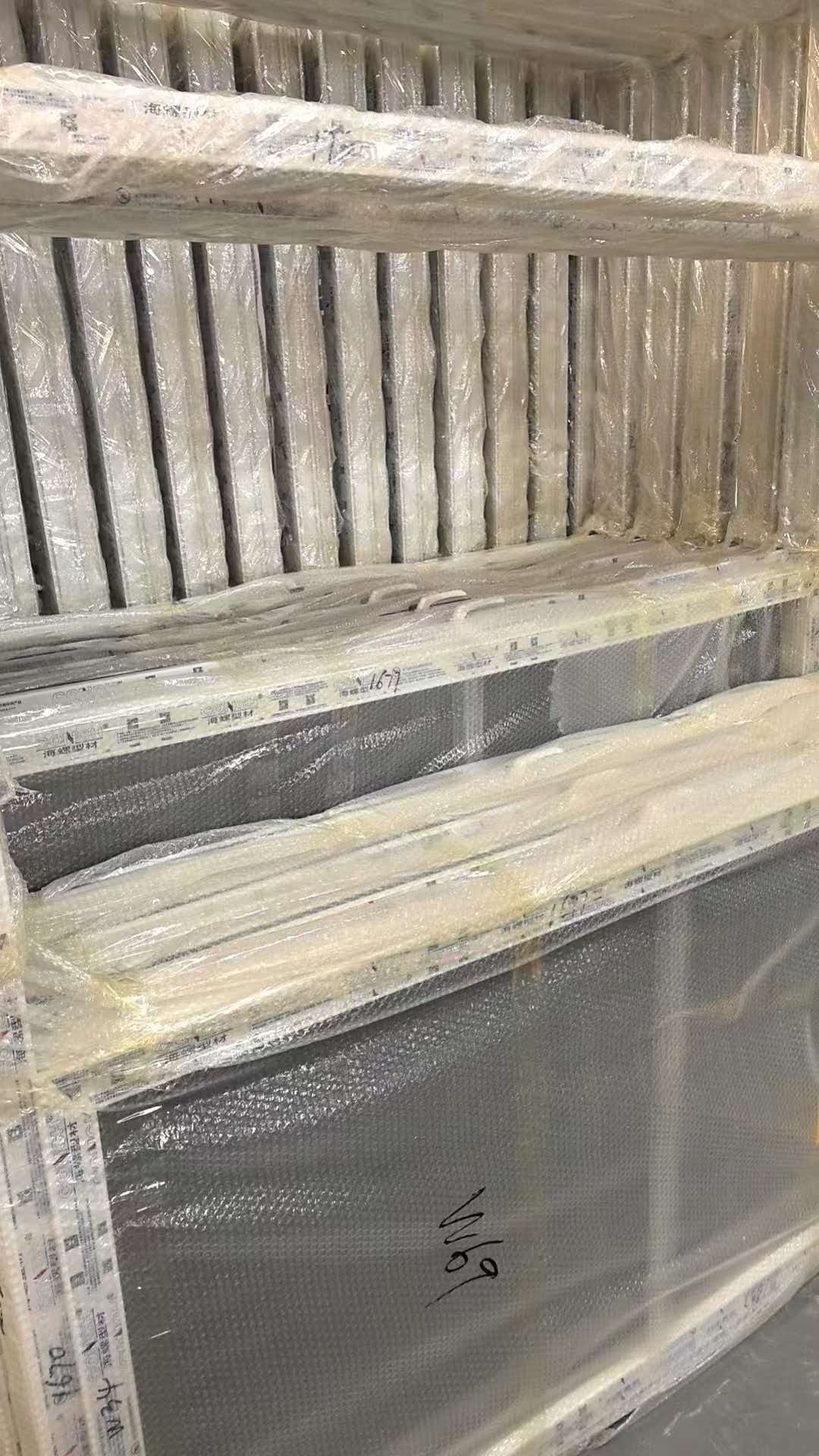
Fully-packed UPVC doors: shipment documents should include the Quality Inspection Report and a commercial invoice carrying HS code 392520.
Have Questions or Need More Details?
Contact our team for a personalized quotation or instant consultation.
Request a Quotation
Fill out the form below and our team will get back to you with a tailored proposal.
WhatsApp Direct Chat
Prefer to chat in real-time? Message us on WhatsApp for instant assistance & quick answers.
- Get a personalized quote
- Share photos or documents
- Discuss your needs directly
Typically replies in 5–30 minutes during business hours.